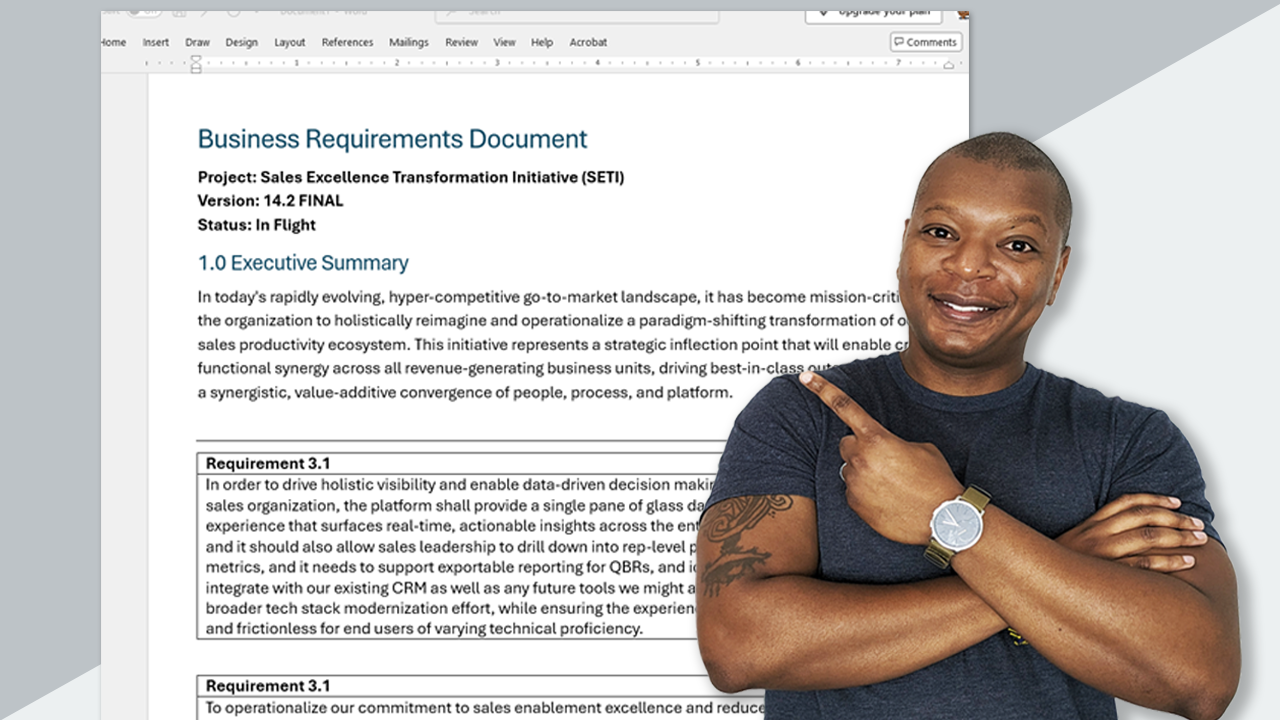
Here is a hard truth about Business Requirements Documents (BRDs): most BRDs are read exactly once. Usually, they are only read by the person who requested them, and they are almost never opened again by the people actually building the product.
If you are a Business Analyst, Product Manager, or Systems Analyst, your goal isn’t just to document requirements; it’s to communicate them effectively to the engineering team. In my latest video, I dive into how to structure a BRD for actual use rather than just filing it away.
Below is a breakdown of why traditional BRD creation is failing and how you can optimize your requirements for the people doing the work.
The Skim Factor: Why Developers Ignore Your BRD
Let’s be honest: everyone skims. Developers skim, product owners skim, and even your own stakeholders skim.
When an engineer picks up a ticket, they need immediate context. If your document requires a developer to hunt through paragraphs of text just to find the one technical requirement that matters to their specific ticket, you have already lost them.
Key takeaway for BRD creation: Stop writing for the archives. Write for the active sprint. Use clear hierarchies, bullet points, and exact mapping to user stories.
The AI Trap: Polished but Pointless
We have a newer problem in modern product development: generative AI.
Today, AI tools make it easier than ever to produce a long, polished-looking BRD that says almost nothing useful. It is tempting to type a prompt and let AI generate a 15-page document filled with corporate jargon. While this might look impressive to a non-technical stakeholder, a developer will instantly recognize it as fluff.
A successful BRD requires critical thinking, edge-case analysis, and precise logic that AI often glosses over in favor of sounding professional.
Quick Answers: Optimizing BRD Creation
To help you master BRD creation, here are answers to the most common questions about writing effective requirements.
What makes a good Business Requirements Document (BRD)?
A good BRD is highly scannable, directly actionable, and free of fluff. It prioritizes exact technical and business requirements over lengthy prose and allows developers to find what they need in seconds.
Why do developers hate reading BRDs?
Developers often dislike BRDs because they are historically dense, difficult to navigate, and force the reader to hunt for the specific requirements relevant to their current task.
Should I use AI to write my BRD?
You can use AI to outline or format your document, but relying on it to write the core content often results in a bloated, polished-looking document that lacks useful, specific details for the development team.
Want to see exactly how to fix your documentation?
Watch the full video above to see a real before-and-after comparison of a traditional BRD versus a developer-optimized BRD, so you can see the difference immediately.